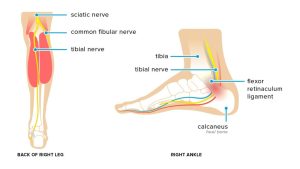
Morton’s neuroma is a thickening of the tissue that surrounds the small nerve leading to the toes. It occurs as the nerve passes under the ligament connecting metatarsal bones in the forefoot (front part of the foot).
Morton’s neuroma most frequently develops between the third and fourth toes. It often occurs in response to irritation, trauma, or excessive pressure, and is more common in women.
Causes
The exact cause is unknown. Doctors believe the following may play a role in the development of this condition:
Tingling in the space between the 3rd and 4th toes
Toe cramping
Sharp, shooting, or burning pain in the ball of the foot and sometimes toes
Pain that increases when wearing tight shoes, high heels, or pressing on the area
Pain that gets worse over time
In rare cases, nerve pain occurs in the space between the 2nd and 3rd toes. This is not a common form of Morton neuroma, but symptoms and treatment are similar.
Exams and Tests
Your health care provider can usually diagnose this problem by examining your foot. Squeezing your forefoot or toes together bring on the symptoms.
A foot x-ray may be done to rule out bone problems. MRI or ultrasound can successfully diagnose the condition.
Nerve testing (electromyography) cannot diagnose Morton neuroma. But it may be used to rule out conditions that cause similar symptoms.
Blood tests may be done to check for inflammation-related conditions, including certain forms of arthritis.
Diagnostic Procedures
Mulder’s Sign (Pinch Test)2: Lateral squeezing of the forefoot with one hand and the opposite hand pushing up on the nerve
Rule out fracture
Reveal soft tissue abnormalities
Mulder’s Sign2: A positive test is a click or snap at the nerve with severe pain
Treatment
Nonsurgical treatment is tried first. Your provider may recommend any of the following:
Padding and taping the toe area
Shoe inserts (orthotics)
Changes to footwear, such as wearing shoes with wider toe boxes or flat heels
Anti-inflammatory medicines taken by mouth or injected into the toe area
Nerve blocking medicines injected into the toe area
Other painkillers
Physical therapy
When to use Physical Therapy in Morton’s neuroma?
Morton’s neuroma Physical Therapy should be considered in the following circumstances:
In early stage Morton’s neuroma. Physical therapy combined with orthotics and over the counter pain relieving medications are a good first step in the treatment of early stage Morton’s neuroma. We define early stage as Morton’s neuroma pain which only occurs intermittently often aggravated with certain shoes.
Post Morton’s neuroma ablation. We perform a number of different ablation procedures to treat your Morton’s neuroma. After we have treated you, you should consider Physical Therapy to help strengthen your muscles and correct any walking (gait) deficiencies that may have arisen due to your previous Morton’s pain. Orthotics also helps with gait abnormalities. If ignored, these gait abnormalities can lead to back pain, arthritis or other problems.
Outlook (Prognosis)
Nonsurgical treatment does not always improve symptoms. Surgery to remove the thickened tissue is successful in most cases.
Possible Complications
Complications may include:
Difficulty walking
Trouble with activities that put pressure on the foot, such as pressing the gas pedal while driving
Difficulty wearing certain types of shoes, such as high-heels
Prevention
Avoid ill-fitting shoes. Wear shoes with a wide toe box or flat heels.
If you are dealing with back pain, joint pain, a sports injury, or limited movement, you may wonder, can physiotherapy help without surgery? In many cases, physiotherapy can help manage pain, improve mobility, restore strength, and support recovery without the need for surgery. Physiotherapy uses targeted exercises, manual therapy, stretching, movement training, and other evidence-based […]
Ligament injuries are common among athletes, active adults, and people who experience sudden falls, twists, or accidents. A ligament is a strong band of connective tissue that connects bones and helps stabilize a joint. When a ligament is stretched or torn, it can cause pain, swelling, stiffness, and difficulty moving the affected joint. Physiotherapy for […]
Knee pain can make everyday activities such as walking, climbing stairs, standing, or exercising uncomfortable. It can develop due to injuries, arthritis, overuse, muscle weakness, or age-related changes. While medication may provide temporary relief, physiotherapy can address many of the physical factors that contribute to knee pain. Physiotherapy for knee pain focuses on reducing discomfort, […]
If you are considering physiotherapy, one of the first questions you may have is, “How many physiotherapy sessions do you need?” The answer is different for every person because the number of sessions depends on the type of injury, severity of the condition, treatment goals, age, overall health, and how well you respond to treatment. […]
Chronic Fatigue Syndrome, also known as Myalgic Encephalomyelitis or ME/CFS, is a complex and often misunderstood medical condition that affects millions of people worldwide. Those who live with this condition know that it is far more than simply feeling tired. It is a persistent, disabling exhaustion that does not improve with rest and can severely […]
Multiple Sclerosis (MS) is a chronic neurological condition that affects the brain and spinal cord. It can cause various physical and neurological symptoms that interfere with everyday activities. While there is currently no permanent cure for Multiple Sclerosis, physiotherapy plays a significant role in helping patients manage their symptoms and maintain an active and independent […]